Strange Gaming Diaries: In Stars and Time, by insertdisc5
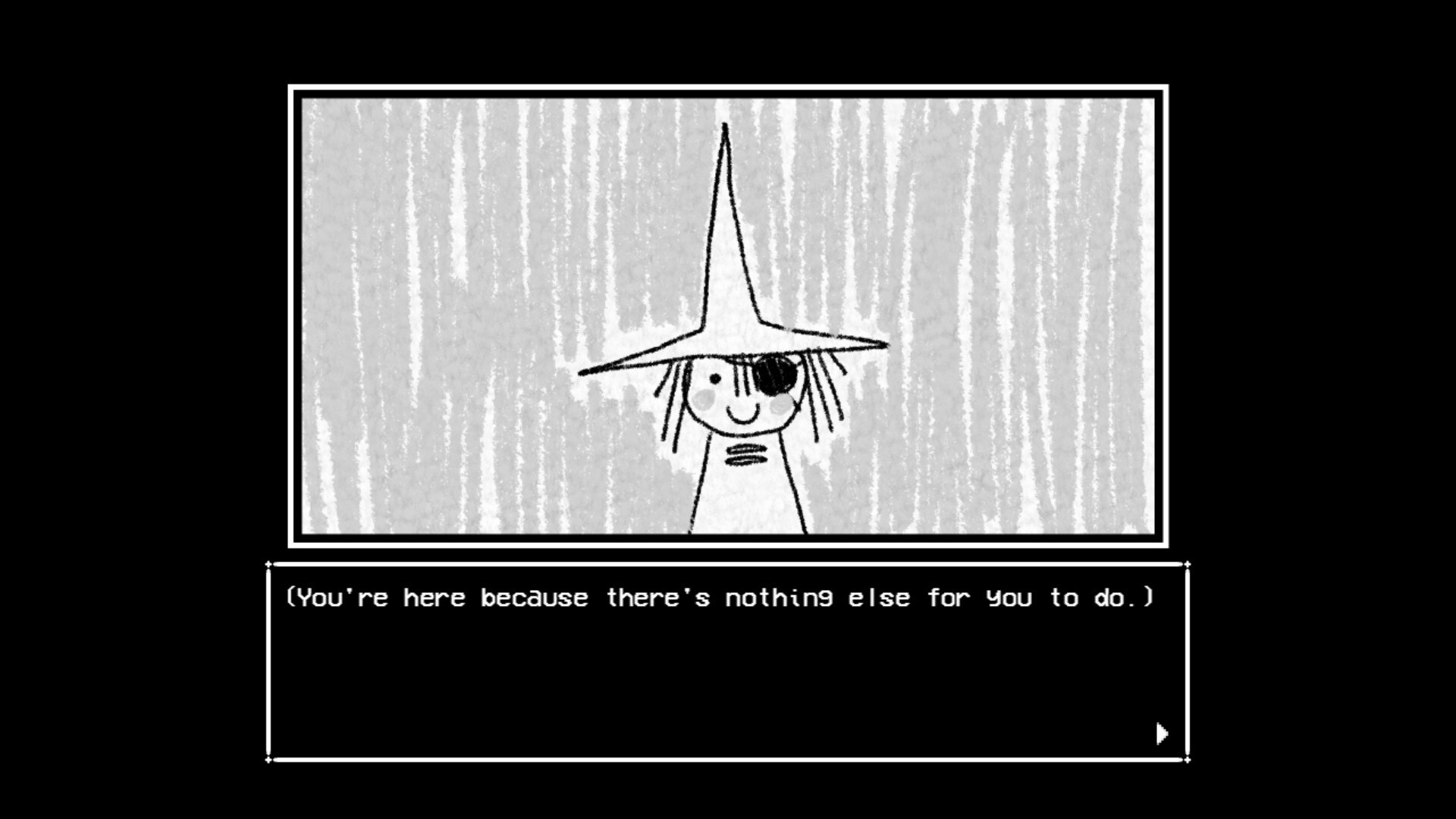
yeah, so, I decided to start playing this game at about halfway through my playthrough of outer wilds. I've been spending probably the past month immersed in not just one, but two separate video games about time loops and existentialism, and actually ended up drawing a lot of really interesting parallels between the two! but, in the interest of keeping things a little more focused and not having too much required reading, I'll probably save those comparisons for a future piece.
so, there's obviously a lot about this game I'm gonna be talking about down there in the spoiler zone, but there's actually also a lot to talk about in terms of fundamentals and stuff that isn't necessarily spoilers! the game honestly blew me away with just how much thought and care is put into its core elements, and there were all sorts of little details that I was catching onto throughout my entire playthrough.
first off, the fact that the game's visuals are as striking and clean as they are despite the dedication to complete monochrome is very impressive, and is a limitations that ended up creating a lot of creativity in the designs and how to separate them! all the main cast are fantastic, not only immediately identifiable but also conveying all sorts of aspects about their personalities and backgrounds at a single glance!
siffrin's outfit is simple and utilitarian, but the swooshy cloak and pointy hat simultaneously communicate a sense of flamboyance and drama that reflects the little bastard themselves. mirabelle is very soft and fluffy, but carries a bit of ornate flair that reflects her sense of duty and importance within her religious community. odile has this long, basic, kinda drab coat that just sort of loosely hangs off of her reedy frame because she doesn't really care about appearances and kinda owns the fact that she's a wispy bag of bones. odile is great. more about her later
and god, these characters. what a fucking home run of a main cast! I've already complimented the dev's writing in my post about her previous game serre, and all of the good things I had to say about that are not only even stronger than before, but on a far wider scale of both mass and depth than their previous showing! this is the kind of game where everything really, really hinges on the writing being good, but I'm gonna go so far as to say that I believe this game has some of the best character writing I've seen in a video game. like, ever.
the thing about in stars and time is that it's a game that takes every single opportunity it possibly can to flesh out its characters and establish little details that not only foreshadow future developments, but add sheer depth to these characters one interaction at a time. every inspection of an environmental object, every item description in the menu, every dialogue option, it all gives you more and more things to learn about this party right when you think you have them figured out—their dynamics are both instantly identifiable and contain a seemingly endless capacity for depth.
not only that, but the time loops are utilized to their fullest potential in this regard! every branching dialogue represents an opportunity to gain multiple perspectives on the party, scenes are constantly having altered or added bits of narration added to them as siffrin's understanding and perspective changes, and even the interactions you go through a literal actual hundred times over the course of the game end up occasionally throwing fun new things at you. this is a story that is clearly being written by somebody who would love to write a billion more words about these characters, and this is one of its absolute best qualities.
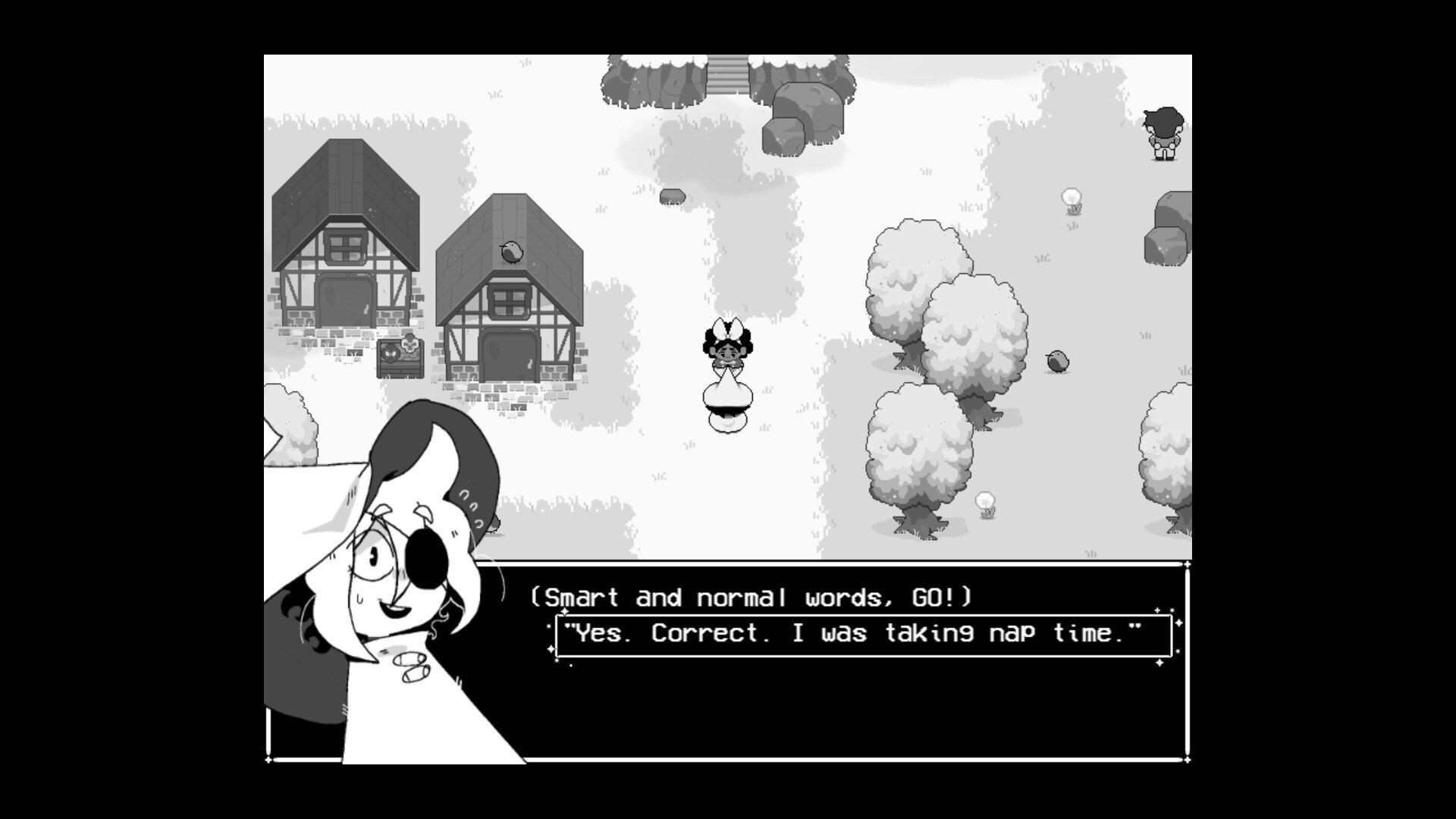
also, the way dialogue is written—like physically placed in the dialogue box—is spectacular. the writing does more of that stuff I praised the dev for doing in serre where dialogue regularly eschews proper typography and generally writing sentences like a normal person in favor of a style that I've heard people call a "tumblr accent", where unintuitive word choices or grammatical sloppiness are purposefully employed to communicate a sort of vibes-based naturalism where the physical structure of the sentence is the key vector of its emotional content. bonnie responding to a conversation with nothing but "!!!!!!!!!!!!!!!!!!" in the special really big text size communicates such a specific energy that using literally any actual word would have immediately dashed.
furthermore, there are lots of moments (especially later on when siffrin starts having Problems) that make use of things like all-lowercase text, putting longer pauses in the middle of dialogue, ignoring the need for commas, putting a bunch of extra spaces between words or even in the middle of words, breaking up sentences across an excruciating number of dialogue boxes, and other tricks that heighten the text and its ability to communicate emotion by having it physically emulate spoken speech in its pacing and general vibes. it's the kind of rule-breaking that can easily become annoying or conceited when done poorly, but by being rigorously thoughtful about dialogue and its pacing throughout the entire game, it really earns those subversive moments and knows how to use them to make a scene that much more impactful.
I could get really carried away talking about all the endless things I love about all five of these characters, and as much as I want to talk about siffrin in particular I feel like the full dissection of his character is best saved for the spoilerzone. so to illustrate this point, I'm gonna hone in on my favorite character in the whole game, which is odile.
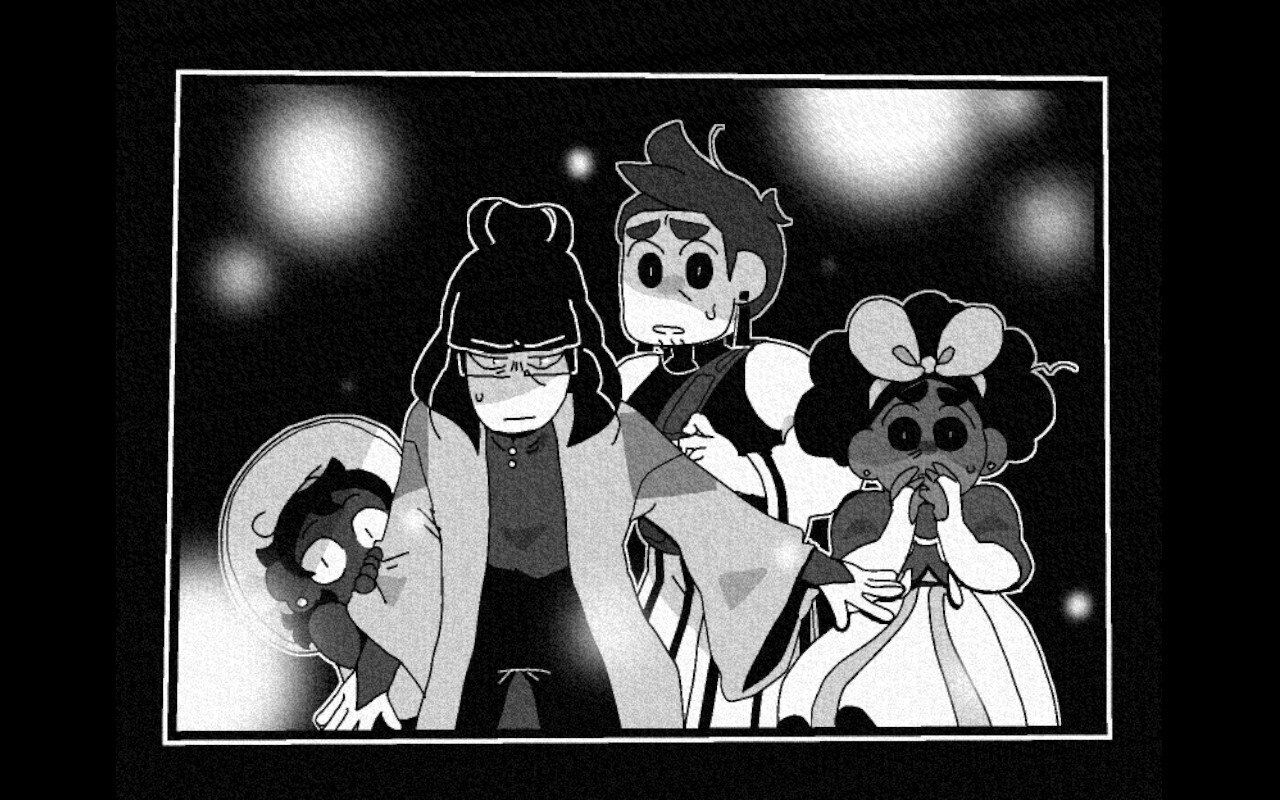
on an immediate level, there's a lot about odile that stands out compared to the others. mirabelle, isabeau, and bonnie create a very powerful force of youthful enthusiasm, peppiness, and a general sense of high energy that drive a lot of interactions forward, which makes odile's sarcasm and introversion into a strong point of contrast. although she's definitely older than the rest of the party by a pretty wide margin, she doesn't slot cleanly into a role of caretaker—in fact, the rest of the party does a lot more taking care of her than she does of them! she carries an air of authority to her, yet doesn't position herself as a superior to anyone and is actually surprisingly reticent to leverage that perceived authority and generally take action despite many situations where doing so could've possibly helped.
plus, despite being the kind of person that on paper would not get along very well at all with the high-energy and passion-driven goofballs of the rest of the party, interactions through the story demonstrate how much she actually enjoys getting to be around them, and the extent to which everybody else understands and cares for odile in turn. her constant playful sarcasm is just her own more introverted way of contributing to the silly bits and fun interactions other people come up with, and is valued just as much by the rest of the party. her presence does a lot to emphasize the kindness and compassion most of the rest of the party is able to bring to interactions with a person who isn't like them, and there are all sorts of small reassurances and considerations that warmed my heart throughout the game.
not only that, but odile also brings out a lot from siffrin throughout the game as well, to the extent that I'd be pretty confident in saying that the two of them are probably the most important interparty relationship of them all—or at the very least, it was their interactions that always felt the most touching to me. siffrin is, despite their happiness in going along with the shenanigans of their more high-energy friends, an intensely private and distant sort of person, and that gives odile a lot of opportunities to demonstrate her own sense of compassion. odile clearly sees a lot of herself in siffrin, and is the person who does the most checking up on him throughout the game to make sure that he's doing okay. he's also clearly the person she's most comfortable opening up with herself, and there are frequent little moments the two of them have where they step to one side of the high-octane tomfoolery and have a little introvert-to-introvert talk. those were always some of my favorite little character moments in the game.
hell, even when a certain spoilery thing that I'll elaborate more on later happens in which the entire party gets very upset with siffrin, odile's priorities never, ever shift from keeping her loved ones safe and making sure everyone is okay, and that still includes siffrin despite everything that happens in that scene. she goes about it in a very brutal and calculated way, but odile is the kind of person for whom being brutal and calculated is something she does because she cares and because she wants things to go well...even when that occasionally leads to moments of tension in other scenes! her near-obsessively analytical nature is both her greatest strength as a friend and the source of many of her flaws!
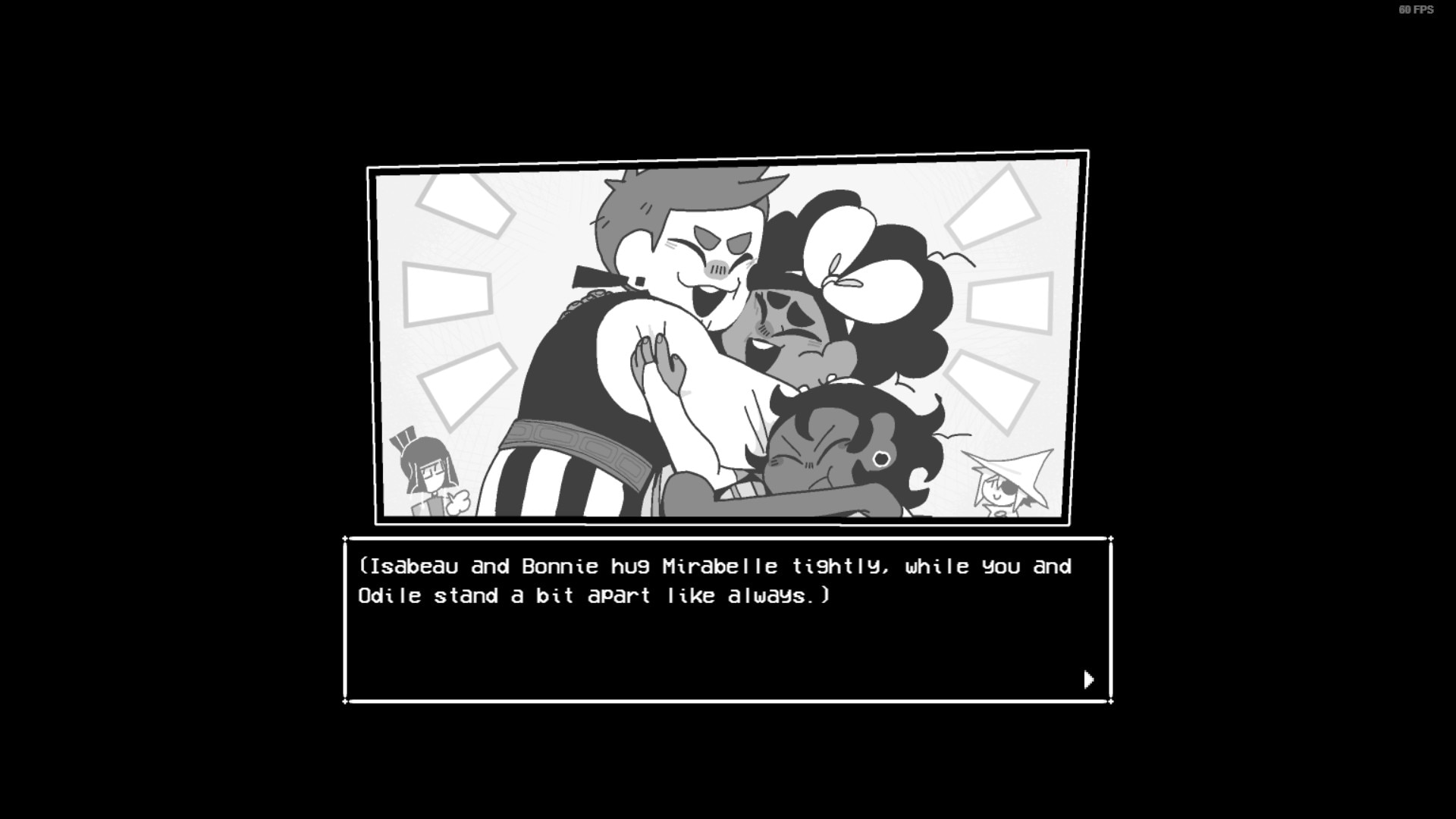
then there are all sorts of small things that I picked up over the course of the game that made me more and more in love with this character. when the party starts talking about body crafting (which, by the way, is a fantastic setting detail in itself) and odile mentions that it's illegal in ka bue, she then immediately has a slick follow-up where it's established that she nevertheless knows what kinds of places you can get body crafting done, establishing both an anti-authoritarian attitude and a pride in that anti-authoritarian attitude.
plus, odile makes a crack elsewhere about her having "two names" but the second one not being one she uses anymore and doesn't care to immediately give out, which I know might be an allusion to later character development stuff that belongs in the spoilerzone, but also sounds a lot like it could combine with the previous thing to suggest that she's trans? like, the body craft thing seems like it could be in reference to her having made her body more feminine and the name thing sounds like it could be a joke about her having a deadname—it definitely seemed to me like the kind of way I'd talk about my own deadname these days, as this thing that I technically have and is kinda funny with how little it applies to me at this point.
and like, not only is odile probably being trans cool for obvious reasons, it's also interesting because this reinforces being trans as having completely different social and personal meanings across ka bue and vaugarde! in vaugarde, going through a gender transition is just sort of an accepted thing people do when they feel up for it, not exactly treated casually but being so in line with local beliefs and social structures that society as a whole doesn't really think much of it. meanwhile, these tidbits suggest that being trans in ka bue is inherently radical in nature, even if odile herself doesn't raise too much of a fuss about it.
there are so many other things too! odile is afraid of heights. the first person she fell in love with was a self-described hatecrush. there are multiple lines of dialogue that suggest she deals with some kind of chronic fatigue or general physical dysfunction that leaves her easily worn out. when she reaches low health in battle her battle portrait shows her as being seemingly excited. there are so many small details to her and everyone else's characters, and I honestly feel like I could write an essay breaking down each and every one of them.
but of course, we have to talk about the star of the show! and in order to make sure I have the full liberty of doing so unfiltered, let's take a trip down to the next paragraph and...
...give you a warning that this next section is where I'm gonna start talking about the more content warning-y stuff in the game. mentall illness, self-harm, suicide, all that. then we can head down a little more and...
⚠ ENTER THE SPOILERZONE ⚠
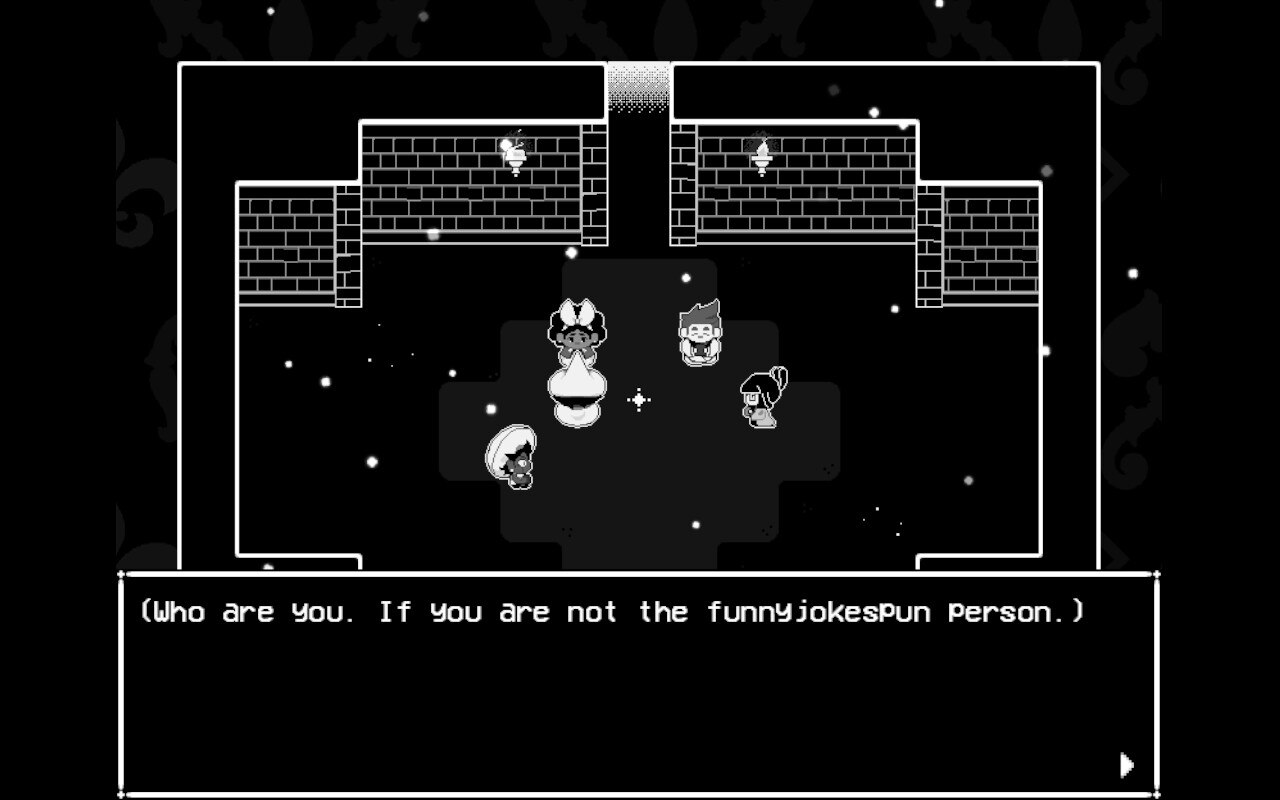
it's funny. in trying to think of suitable comparisons to the relationship the player has with siffrin throughout the game, my mind keeps coming back to theater. classical tragedy, to be exact!
see, in stars and time does a very special thing in that the player themselves is given next to zero direct presence in the narrative. their actions just guide siffrin along towards whatever actions he wants to take and allow the story to move forward. there's a clear divide between what siffrin decides is the best thing to do and what the actual best thing to do is—which is usually something to the effect of desperately begging this idiot to get help and be vulnerable for once in their fucking life.
a subtle but constant factor in emphasizing this is the fact that there is no third-person narration in this story, with everything instead taking the form of internal dialogue inside of siffrin's head. by equating the two in this way, you are receiving a near-constant stream of the main character's thoughts and feelings, and thus are able to understand most of why he does all of the things he does.
but, at first, you don't understand all of it. see, the genius thing about in stars and time is although it's about saving the world or breaking the time loops or what have you, the real primary gameplay loop is learning about siffrin. not only does the constant stream of information give you all kinds of pieces to work with, there are also key mysteries like his place of origin and his affinity for stars and his crippling emotional codependency that are hinted at and slowly unpacked over the course of the entire game, things that he knows about himself (and thus desperately keeps hidden) but the player still doesn't.
this secrecy creates an asymmetry of information that establishes, early and often, that siffrin is not someone we're supposed to be projecting onto as a vessel for our interactions in the world; they're the central piece to this whole story that we're forced to watch make all of the unexpected, often bad decisions they do. we are more audience than player in this game, despite the fact that we're pushing the buttons the entire time.
and it's important that this asymmetry is established, because this prevented me as the player from feeling frustrated when siffrin does some obviously stupid shit or has an obviously terrible idea that I'm forced to allow him to do. the entirety of act 5 is one big example of this, a harrowing mental breakdown that I'm compelled to move to its completion with the understanding that the little guy I'm controlling is probably going to do all kinds of awful things that I won't have any say in. but that's okay, because siffrin is established as a character with independent agency beyond the actions I take in the game! it's a very smart way to let the main character truly deteriorate without breaking player immersion.
plus, the totality of this low point is wonderfully established through all the little iterations and changes to each loop's contents that display in frightening detail the extent to which siffrin is being worn down by their repeated failures and detachment from reality. the game is very restrained with how slowly and gradually it turns up the heat of the coals siffrin has to constantly dance on, with their narration and dialogue portraits going flatter, their thoughts growing colder and more nihilistic, and the writing style going from dramatic and eccentric to crushingly taciturn. one of my favorite little details that I noticed was that, at some point, the combat dialogue like "You wink and attack!" stopped ending in exclamation points and were replaced with lifeless periods instead. it's such a small thing, but it does a lot to contributing to the background radiation of the thing.
this gradual decline is also interspersed with more extreme outbursts and breakdowns, from the defeat at the hands of the king to the later betrayal and murder of bonnie. which like, brief aside, I was not expecting this game to be willing to kill the child. it does it off screen and leaves it a little ambiguous, but I know you're meant to come out of that scene knowing that bonnie just fucking died.
which leads into another point, which was that...I was kinda expecting this game to pull its punches a bit? not for any fault of its own, but like, when games like this get picked up by online fandom spaces and blow up in popularity, it comes with a bad side effect of either the fans giving the impression of the game as being more groundbreaking or subversive than it actually is, or the game itself communicating that and the fans uncritically believing it. I've been burned by OMORI and smile for me in this regard, and this game very much has a lot of genealogy in common with those ones.
but not only does in stars and time not pull its punches, it punched even harder than I expected it to. the first conversation about siffrin's dagger being a potential shortcut for looping was something I decided to fully lean into to see just how far the game was willing to go, and not only was the part where you hijack loop fucking terrifying, the dagger carried such a feeling of dread that persisted even after I'd decided to use it a few times. there is of course, as loop themselves points out, a difference between arranging accidents or touching a tear and running yourself through with a blade. there's a derealization of the physical body that it encourages, a dangerous sort of flippancy and willingness to destroy oneself on a convenient whim. as if that wasn't enough, it's suggested by the dialogue options that present themselves if you do go through with using the dagger that siffrin has already been harboring suicidal thoughts that this is just viciously enabling.
and the dialogue you get at the game over screen the first few times you do this? (You killed yourself.) no jokes, no euphemisms, no frills, just a flat and brutal statement of facts: (You killed yourself.) that the game takes no effort to censor itself throughout this process shows a courage that blew me away.
siffrin's mental state as the loops progress gets worse, to be sure, but it gets worse in a very messy, complicated, and non-linear way. he becomes emotionally flatter and more closed-off while also simultaneously becoming reckless and impulsive in his attempts to get things done as quickly as he can so he can get to the parts that matter. he becomes dismissive and callous of the people around him from the sheer repetition of their actions, to the point that later on in the game he starts struggling to even see them as people in a meaningful capacity. yet, he's aware of this dehumanizing thought pattern and regularly flagellates himself for it, calling himself disgusting and becoming confident that they would hate him if he knew the kinds of thoughts he was having or the ways he's had to lie to them.
the complexity of siffrin's mental illness and traumas and the depth to the way they inform his behavior is the most important part of all of this, because they allow him to become more and more erratic, hostile, and generally problematic while never losing those believable and sympathetic qualities that made me as the player want to stick with him and see things through in the hopes that things would get better. I sympathized a lot with siffrin as the game went on. it's not too hard for me to look at the past few years of my own life as a series of loops of trying and failing and seeing a lot of the same kinds of things every time. I understand the way patience and civility give way to hysterical, reckless impulses. I understand the compulsion to punish yourself for the way you treat everyone in your own head. I understand the ways you can lose touch with reality and your sense of self and personhood after spending too much time being ground into dust.
and the most brutal part about this game was, it kept getting so much worse. there are multiple points at which siffrin and the narrative structure itself suggests that you've found the true path to victory, even using a little bit of metanarrative cleverness by leaning on tropes like "you need to complete everyone's sidequests to unlock the true ending" or "you need to convince the final boss that fighting isn't the answer" to set up expectations and joy and hope.
the first time going through all the friendquests was so very moving to me. isabeau talking about wanting to keep the child in him safe, and building armor around that person until it becomes the real thing, made me fucking cry because despite multiple years living comfortably as a trans person that still spoke to something I had struggled to stay in touch with throughout my entire life. all of the other scenes were utterly wonderful too, in a way that once again swept me away with how heartfelt and sincere their writing was.
but then it doesn't work and you're back at the meadow and siffrin is completely devastated just like I was at that point too.
and then you have to do it again.
like, holy shit, nothing made me feel such an awful tangle of emotions than having there be all of this touching and joyous dialogue about finding family in the people you've come to live with over the years and rediscovering yourself as a person, dialogue that made me fucking cry, and absentmindedly holding down the shift key to ignore the whole thing because you need to get to the next bit. not to mention how bad it makes siffrin feel, with the internal narration going from his genuinely touched reactions of happiness to bleak hopeless misery. needing to sit there and read narration about how much siffrin fucking hates themselves while the touching emotional music plays in the background and you see the face of a loved one looking at you with love and life in their eyes hurt me so much I genuinely needed to put the game down for a little while.
and it just keeps getting worse from there. the aforementioned attempt to get the king to stand down goes horribly, and then you click the save point and realize oh, you're in act 4 now. this game never had only three acts. I've never seen it addressed but it's such a small yet powerful betrayal of trust for the game to set up this idea that the game will probably be over with the third act, because y'know, most stories work like that, and then it just keeps having there be more acts. it creates this total sense of dread and the feeling that you don't have any idea what you need to do or how many more loops you're going to need to go through, which does a lot to establish empathy with siffrin, who has very much been having the same reaction to events.
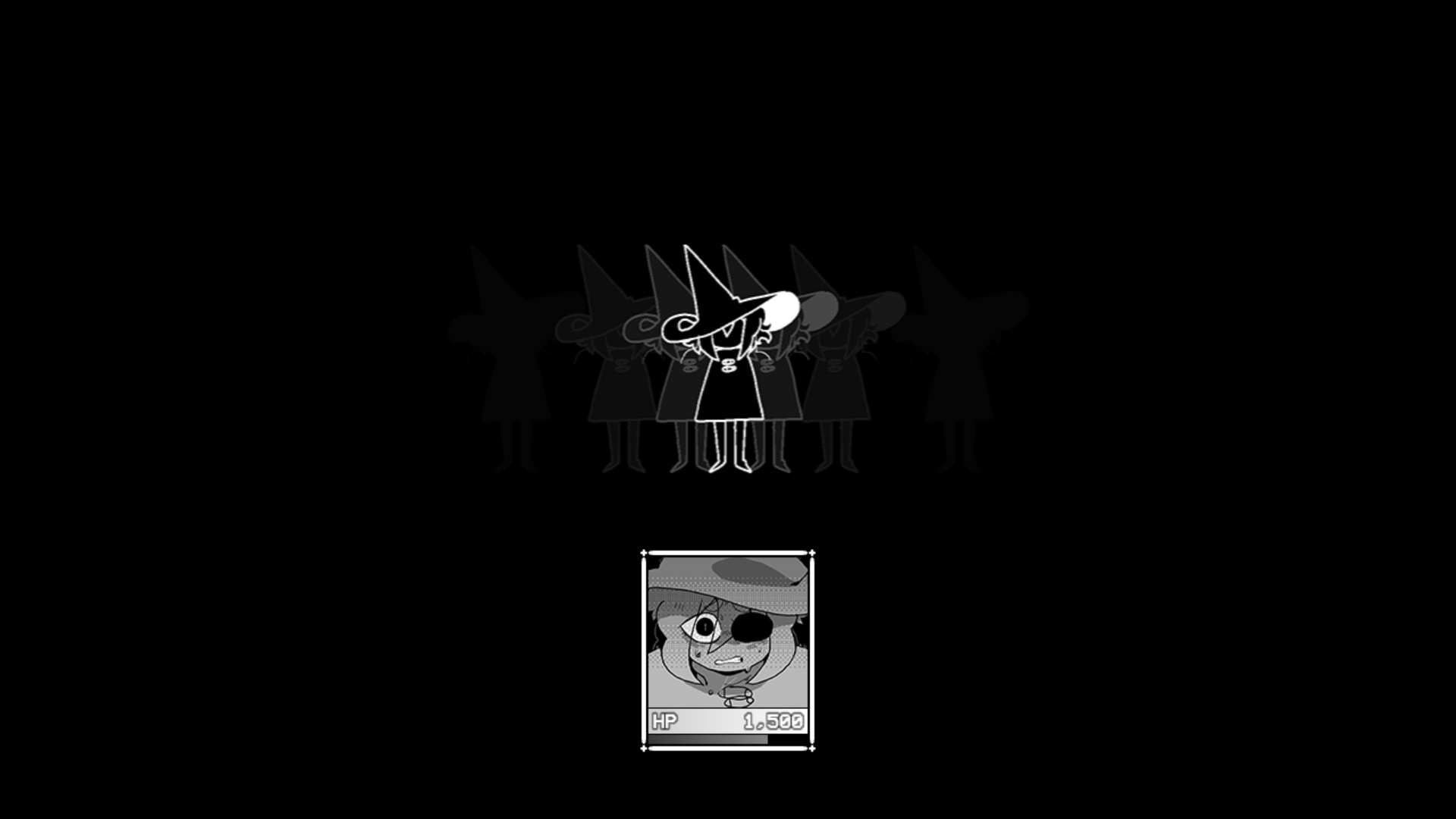
then comes act 5, which I described before as scary but I really need to devote some time to establishing just how dreadful the whole thing is. walking into town and hearing the distorted music and the fucking change god's glitched out fucking face freaked me the hell out. all the visual distortions through the whole thing and especially the way the house's warps are swapped around at seemingly random are the kind of thing that plenty of games do to make things spooky and establish that the main character is freaking out, but it hits so much harder in this game because it's a game that at all other points before this encourages the building of familiarity and muscle memory. the layouts of the town and houses, the dialogue sequences, they all burn themselves into your brain over hours and hours of playing, and so to have everything scattered around and incorrect is a ruthless attack on the player's sense of safety.
also, naturally, all of the text you get for examining and interacting with things is horrible. siffrin's internal narration rapidly alternates between lifeless pragmatism and frenzied rambling, he slaughters all of the enemies he comes across, and he experiences all kinds of hallucinations that take the form of things like entire dialogue sequences from previous loops playing out, completely unaltered, like absolutely nothing is wrong. the whole experience was utterly bone-chilling.
act 5 also contains what I think is the most horrifyingly intense depiction of self-harm I've ever read in my life. I think I need to talk about it for a bit. I'll put it in another little dropdown for you, just in case.
self-harm talk quarantine
the thing is, it's not even that big of a deal in the narrative itself. it's just three lines, an extra little bit of flavor you get for finding and picking up the glass shard on the second floor. in previous loops, siffrin messes with it a bit and ends up cutting his finger, in such a way that I always felt seemed a little bit too consistent and dismissively regarded by siffrin himself to have been an accident. this and other things establish by this point that siffrin definitely has self-harming impulses, but they're usually confined to things like either the little nicks with the glass or smacking themselves in the head. still undoubtedly self-harm, but comparatively low on the severity scale.
picking up and using the glass shard in act 5 gives you these lines of dialogue:
(You pierce a tiny dot on the back of your arm with the point of the glass.)
(You make another, and another, and another.)
(Stars!!!!!!)
like, christ. jesus fuck. it's not just the fact that siffrin goes from the plausible deniability of messing with a piece of glass in his hand to jabbing holes in himself without any sort of hesitation, but the fact that it's so clearly done in a manic fit, where all these feelings of desperation and obsession and loneliness and wanting to die all crash into each other and end up with him doing something horrible and feeling happy about it. the pain isn't even anything he remarks on. does he even feel the pain? has his own body become this lifeless thing that he mangles on a whim, a hysterical impulse? or can he feel it, and is the only way he can allow himself to think about something that makes him happy by hurting himself enough to stop thinking about anything else?
either way is awful, of course. but at the same time, both of them were relatable to me. I self-harm very irregularly these days, and never this severely, but there's an extent to which that might be less because of any particular uptick in mental stability and more because I don't always trust myself around sharp objects nowadays. it's something I'm still coming to terms with about myself, and to have that so clearly reflected in this game really took me off guard. and, I think maybe even more than anything else, it's also why the ending and overall emotional resolution of the game hit so hard for me.
the game, of course, ends with siffrin finally allowing himself to be vulnerable and talk about his fears of abandonment with his loved ones. I was always certain that was going to be how the game ended up, with it being the one thing that siffrin perfectly dodged and weaved around doing at every possible opportunity. the encounter with mal du pays was a well done little combat-encounter-as-conversation-with-self, and the final encounter between siffrin and the rest of the party was cathartic in all the right ways after so much time spent in uncertain misery.
it's not just the fact that siffrin manages to open up to everyone and tell the truth at the very end that really hit me, emotionally. I've kinda already been through the wringer of realizing that I need to let myself be honest with the people I love! I've already had that painful series of revelations, and so even though I was beside myself with joy on siffrin's behalf for his success, that wasn't the part of all this that really knocked my lights out.
that was something that isn't really spoken to directly, but is a strong theme throughout the epilogue and also, to an extent, the entire game as a whole. because the striking thing about this ending sequence is that it comes after probably the single worst sequence of events in the entire game, with siffrin saying a bunch of awful shit to his loved ones and hurting himself worse than he has in most of all the rest of his loops. yet the rest of the party still comes to his aid, they take on the burden of defeating the king, they walk him through that hallway, and they encourage him to calm down when he fully loses control of himself so he can talk things through and come out the other side.
at no point is siffrin made out to be a burden, despite the fact that he did hurt a lot of people and that all of this is unquestionably all his fault. that he was damaged enough to have wrought all of this isn't something that's held against him, and is instead met with patience, kindness, and a promise to do what they can to hold him accountable. all of the awful things siffrin did to themselves earlier that day aren't just going to go away, after all, and all sorts of deeper traumas and mental illnesses are spoken to throughout the game that don't receive any sort of definitive closure. because that's not how it works, right? you don't really get to have closure on these sorts of things, a lot of the time. you break, and you have to stay broken for a really long time.
but being broken doesn't mean you can't be taken care of and loved by people. being a pile of mental illnesses in a big wizard hat that just nearly ended the world because you couldn't stand the thought of losing your friends isn't something that makes people give up on you, and it isn't a reason to give up on yourself. something I found very understated and powerful is the way odile is also constantly cared for by the rest of the team when it comes to her physical frailty and also, at a later point, her major fear of heights. there are a lot of ways in which she struggles, but she's unquestioningly, unconditionally helped through all of those things by the people around her, because she's willing to be honest about things that she struggles to handle.
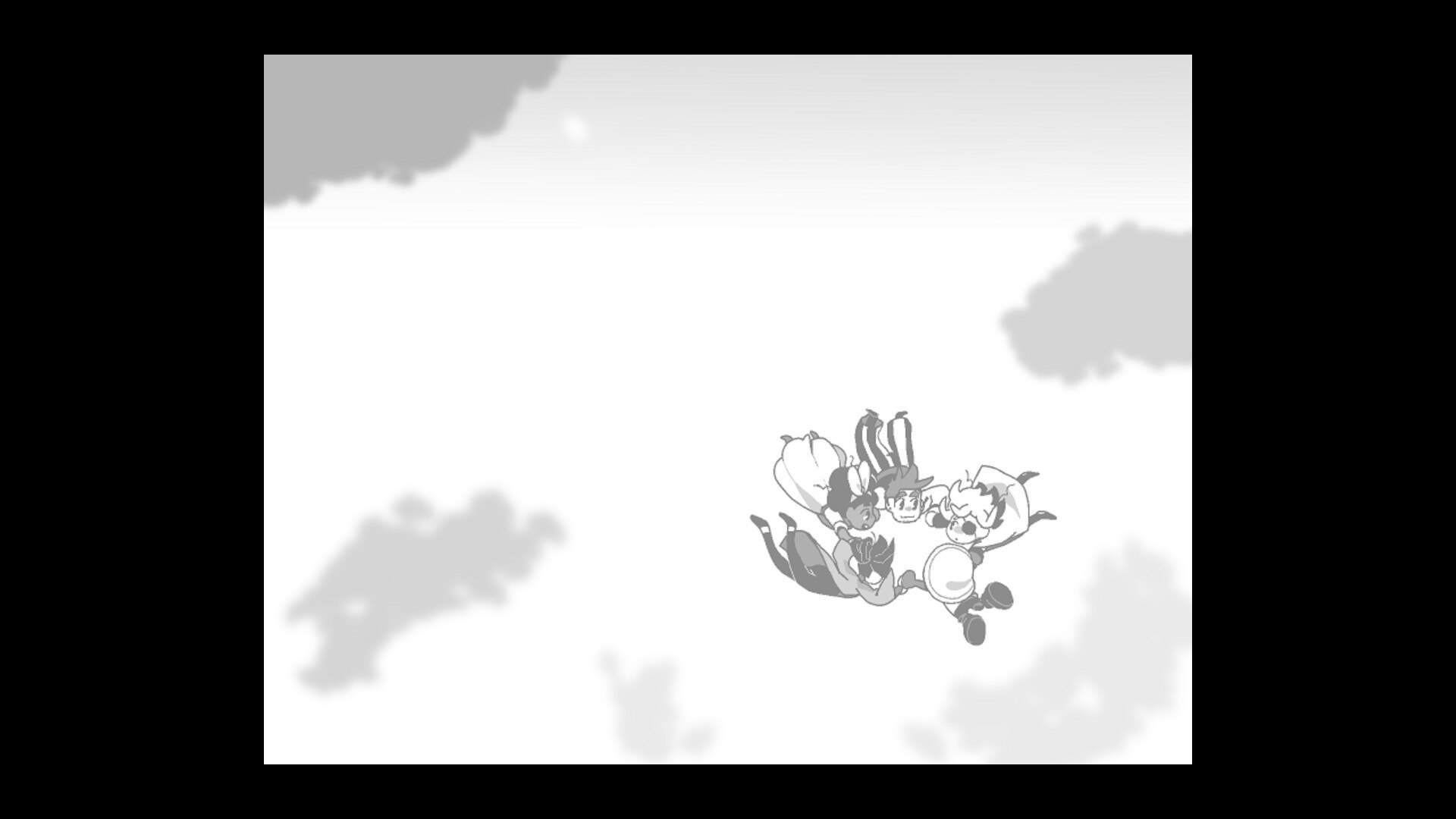
I've spoken in various places about it to various degrees, but I'm kind of a wreck of a person? between a chaotic slurry of traumas and mental illness, as well as the chronic fatigue and other physical ailments that come with all my assorted issues, I'm a person that needs a lot of help in ways that often feel embarrassing. if I don't have somebody literally pull me out of bed in the morning, I can have trouble getting up in any reasonable timeframe. I struggle to put enough food in me to survive because my sense of hunger is completely shot and I'm awful at establishing routines. just the other day I had to ask the loved one who was visiting and who I was supposed to have been cooking dinner for if she could mince the garlic for me because my brain freaked out at the sight of the knife and I had to leave the room and take deep breaths to keep myself together. I have a horrible memory for all kinds of reasons, which is frequently obstructive and sometimes prompts bad dissociative episodes. not being able to remember things is scary, for me. you can imagine how I felt about it being one of the most prominent symptoms of siffrin's own mental illness.
every time something like that happens, I flinch and expect to be criticized for it, or to otherwise have my ineptitudes noticed and remarked upon. often, when I spent most of my time in less healthy company, that was exactly what happened. but these days, the people around me never hesitate for a moment to help me with all of those things. I spent a while not understanding it, feeling like I needed to be able to reciprocate in some way, to provide for people, to help them or generally do anything besides passively leech off the effort of everyone else around me.
it was a few months back, in a conversation with one of my girlfriends, that she said something lifechanging to me, and that I see spoken to constantly through the actions of the characters in this game. I can't remember the exact words, but it went something like: "you don't have to be able to help someone to be their friend." that perceived unfairness, that unevenness of what I was able to do versus what other people were doing for me, it was all just me being unkind to myself and working with poisoned ideas of what loving someone truly means. people can help me and I can just accept that and that's okay. me being fucked up and dysfunctional and having a lot of these kinds of needs doesn't mean I'm being a bad companion. they still love me. they're doing it because they love me.
it was really touching to be able to see that kind of relationship between the characters in this game, and for the unshakable determination of that kind of relationship to be what ends up helping siffrin through all of these terrible, terrible events. it's a story about love that's willing to acknowledge that loving someone, more than any nebulous high-minded concept of compassion or forgiveness, means being honest about the things you lack and need help with. it spoke to the kinds of relationships that are changing my life right now, and made me feel so much more love in my heart for all the people in my life.
fuck's sake, it made me realize how much I wanted to confess my feelings to the dear friend I had been playing the game alongside the entire time, and how I owed it to myself to take those feelings seriously enough to speak to them. it's gonna have a special place in my heart forever, just for that alone.
visit the dev's website!
keep up with the dev on their tumblr, or their bluesky!
play the prologue, START AGAIN START AGAIN START AGAIN!