Strange Gaming Diaries: Slay the Princess, by Black Tabby Games
spoiler warning for everything!
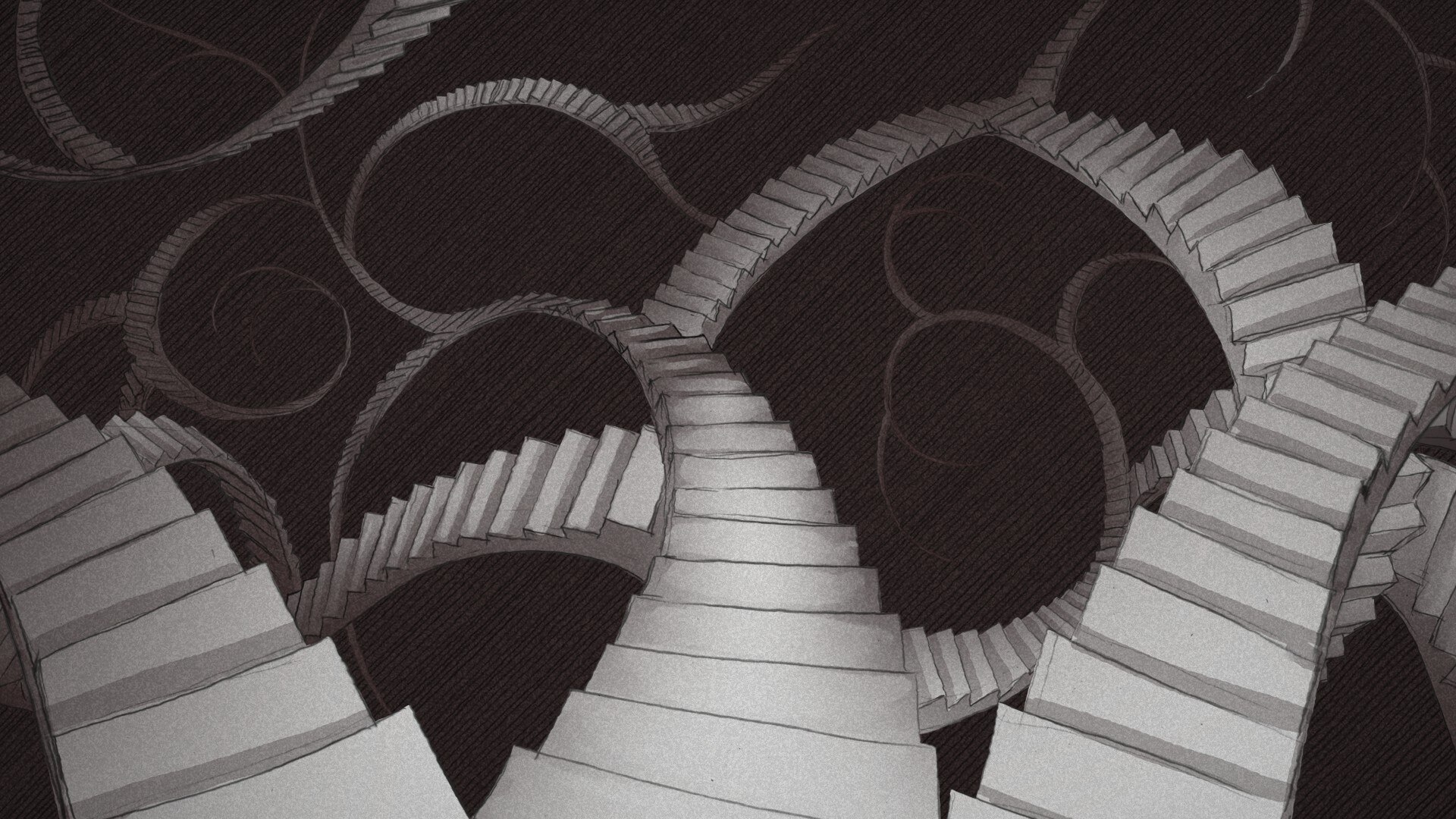
when I booted up slay the princess, I thought I understood the kind of subversive video game it was. I've seen it plenty of times before—game tells me to do something, game assumes I'm going to do the thing it tells me to do, I'm given the chance to deny it and go off the rails. I'm told to slay the princess at the top of the hill, and I turn around and walk in the opposite direction.
then the narrator twists my arm such that I end up at the hill anyways, and still, I think I understand. okay, so this is one of those games where the narrator exists as a sort of agent of the narrative, and I a dubiously willing participant. we'll be fighting quite a lot, I imagine. got it. I turn to leave again, daring the game to blink and reveal the facade.
this repeats a few more times, until eventually the narrator describes the world starting to break down, such that there is nothing but the cabin in the woods. he insists that I care more about irritating him than the fate of the world, and I resent the assumption a bit, but I ultimately can't really blame his frustration.
a new character chimes in, named "voice of the hero." I'm a little bit unsure of what that's about, but it's moved on from pretty swiftly as the narrator throws his hands up and exasperatedly declares that the world has ended and everyone has died. the screen goes black, and I relax a little bit. now's probably the part where I get kicked back to the title screen, maybe get a little credits roll first. it was a fun little diversion, but it's probably time to get back to the rest of the game.
but then I see "Chapter II: The Stranger" fade onto screen. okay, there's follow-up! not too unusual.
we fade back to the initial scene of the path in the woods, with giant walls erected as though to spite me. probably the work of the narrator, right? but when confronted about the previous events and the presence of the walls, the narrator insists that he doesn't know anything. and what's more, I really don't get the impression that he's lying. we're still going. the game has yet to blink.
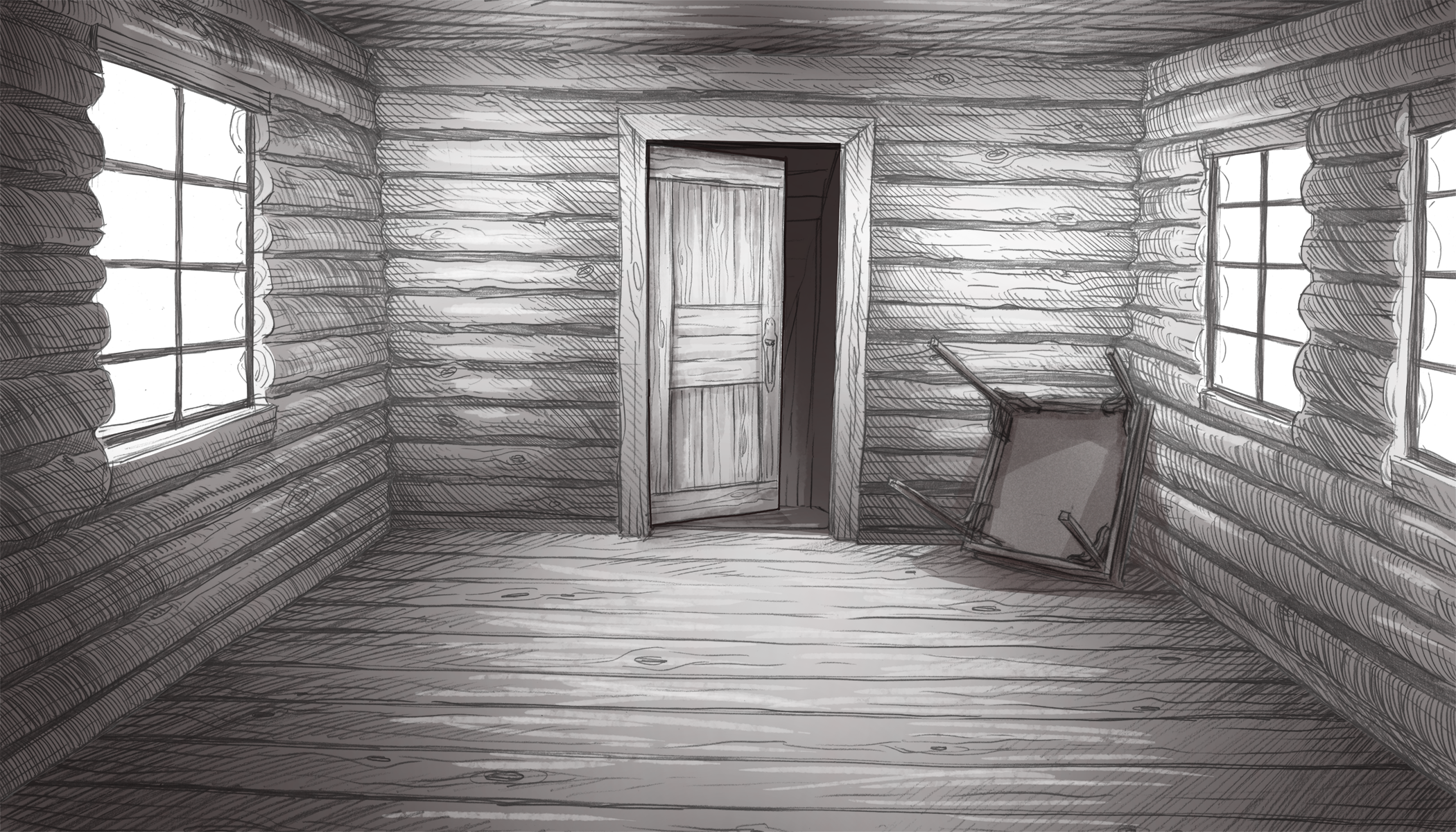
more voices chime in. the voice of the hero is joined by another voice of someone called "the contrarian," and the two of them discuss the strangeness of events, including the things from the past that the narrator seemingly can't remember. I go into the cabin, which has been rendered as an amalgamation of multiple different construction styles for reasons unknown to me, and which the narrator describes in the same way you'd describe any other unsettling locale—he doesn't seem to register the broader metanarrative implications of this, describing the physical properties of the place and nothing more. a mirror hangs on the wall, unremarked on by the narrator, but I'm still given the option to approach it. I do so, and it becomes obvious that the narrator is incapable of seeing it, as he complains on my fixation with an ordinary section of wall. suddenly, I feel like I no longer know who the narrator is supposed to be in this story.
I reach out to the mirror, it fades, and as it does, I see a gangly, scaly limb with gnarled claws reach out from my first-person perspective. nobody, not even those voices from before, remarks on this.
suddenly, I feel like I no longer know who I'm supposed to be in this story.
slay the princess is a difficult game. not in terms of actually being able to finish it—it's ultimately just a visual novel—but its layers of narrative convolution and obfuscation make it a very dense read. unlike a game like anthology of the killer, where its intellectualism is couched in what's fairly straightforward storytelling at the end of the day, this is a game that is relentlessly high-concept and demands that you sit yourself down and chew on many of its ideas.
this isn't even necessarily because the writing is hard to understand, per se! with a few exceptions, most of what you experience is delivered with not only cunning wit in its writing style, but exceptional performances from the whole voice cast. this difficult nature is instead a result of how uniquely confrontational the game is in its interactions with the player. the central conceit of the game—slaying a princess in a cabin in the woods to save the world—is presented with an expectation of self-evidence that naturally leads to interrogation from the player, and only rarely does this ever give you anything more than half-answers and further questions.
most of what you do in this game is argue with the story you're being told, but it's a story that no one seems in any singular control of, and that is in fact being fought over by multiple competing forces. this demands a much more intense level of engagement with the game, and I never felt checked out or safe in knowledge of where things were going for a single second. that's really something impressive to keep up for an entire runtime!
this style of storytelling encourages comparison with another popular narrative-focused game in which the player and the narrator take on adversarial roles in their control over a story: the stanley parable. there's even a reference to it in gallery! but this is where slay the princess's choice to be told as a visual novel sets it apart, because where the stanley parable's freeform movement frames defiance of the narrative as puckishly exploratory, slay the princess is able to constantly present you with choices and decisions that demand consideration.
the range of available dialogue options in any given situation serve just as much purpose in telling the story as what actually happens when you select them; you aren't wandering outside of the lines, you're playing a fierce game of tug-o-war with the story, your freedom to select the options you want tempered by the tension of knowing that your agency is at the total mercy of a linear narrative, and that the ability to choose can be—and sometimes is—taken away from you at a moment's notice. it's a game that understands the medium of the visual novel so intimately that it's able to leverage its fundamental structure as a thematic and emotional component of its story. it's fucking brilliant.
as for the kind of story the game uses that understanding to tell, it becomes clear that despite the seemingly clear-cut presentation, this is a story that speaks not primarily in terms of cause-effect relationships and character motivations, but with more abstract concepts of agency, identity, archetypes, and meanings. everything is presented as though it's literally happening, but what all of those things mean is shifting around so constantly that it can't be pinned down on any basis of realism.
take the princess, for example. later loops through the main path of the game see her changing form in response to your actions, from a playful ghost to a bitter captive and more. she's referred to as a "creature of perception" by the greater entity connected to all of them (later named, and thus called for the remainder of this entry, the shifting mound) and is more explicitly explained as malleable in response to the desires of the player character. when they take the knife and come into the basement expecting danger, she takes on a more confrontational and aggressive tone. if they leave the knife behind, she becomes demure and innocent.
yet each of these princesses is still a character, still written with motivations and behavioral traits and all sorts of other things that makes each of them compelling. through the rest of my playthrough of the game, I delighted in the playful and impish nature of the specter despite her macabre nature, I saw a desperation in the damsel's deference to the player character's desires, I found myself sympathetic to the prisoner's bitter aggression, and I was captivated by the combination of sadism and innocence shown by the nightmare. they all act as reflections of that central concept, yet in each one is an individual gleam that makes them fascinating to engage with and try to understand as people.
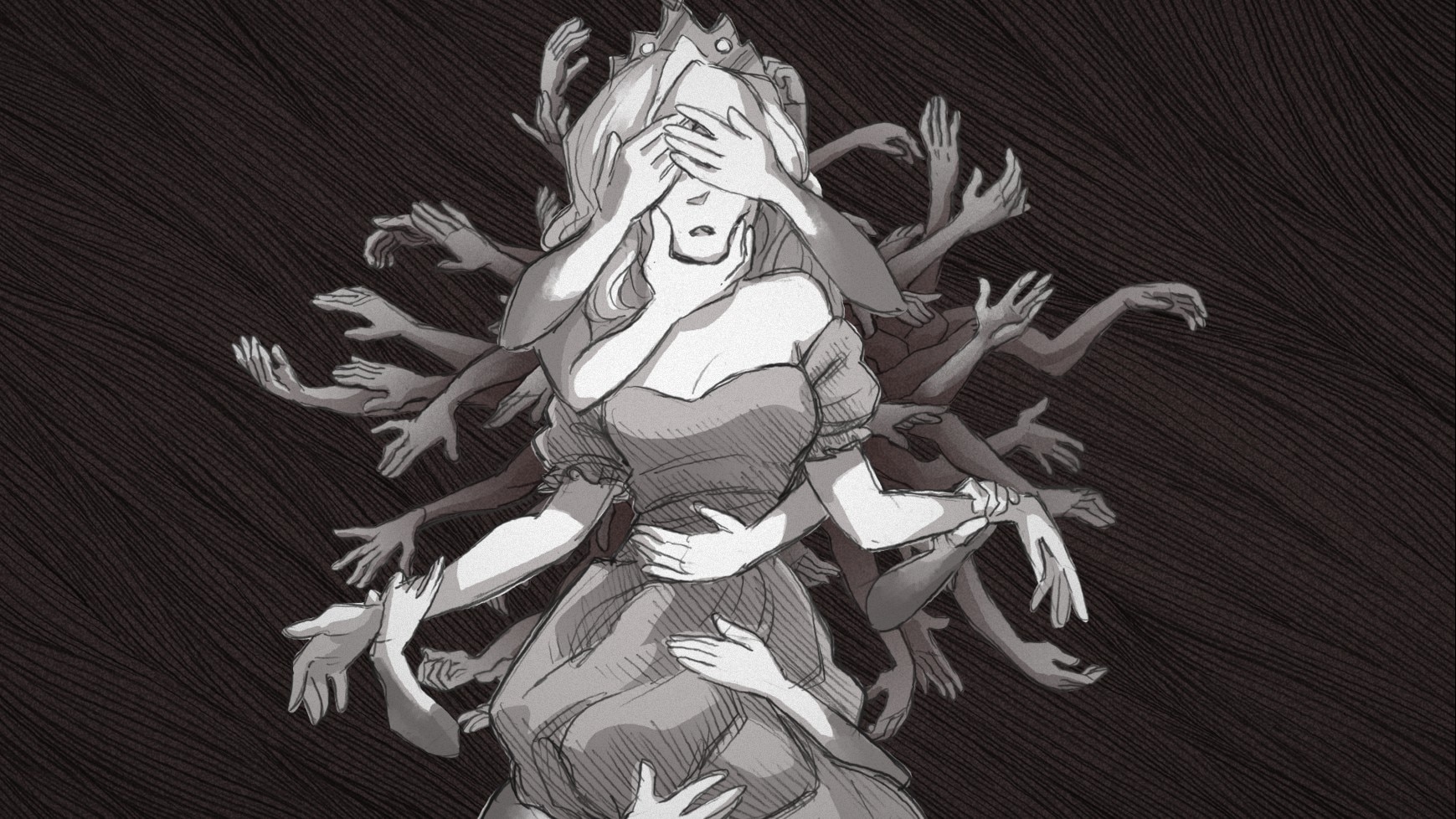
one by one, they're brought into the shifting mound's embrace, and everything is stripped away but me and her. the voices, the vessels, and even the clarity of the surroundings all faded, and I was left to contemplate the nature of things with this apparent peer of mine. each vessel is held in the mound's many-armed embrace, caressed as a beloved treasure and spoken through via puppeteering at the same time. these interludes are powerfully meditative, with the repetition bringing a sort of ritualistic overtone to proceedings that enhances the experience further.
from these conversations, you also come to understand the shifting mound's nature and guiding philosophy—the vessels have value to her for the new perspectives they offer, and she speaks in profound ideas of change and chaos. many of the dialogue options interrogate the paradoxes in these perspectives, such as the idea that she can exist as an independent being with her own desires despite being the sum total of multiple other beings, yet she gently refutes that to exist as such a contradiction is still undeniably to exist. if the player asks her how she can stand this incomplete nature of hers, she responds simply: "as easily as you can stand to be you."
once you grant her the final vessel, you are brought to a confrontation with the narrator, who explains the meaning of all of this: that the player and the princess, the shifting mound, are nascent gods cut from the fabric of life and death, one destined to kill the other to bring about a world without the endless cycle of chaos and suffering. you're able to ask the narrator a number of questions, ranging from his motivations to more elaboration on these ideas—but, interestingly, you do not get the chance to ask every question you possibly could.
in a game otherwise very permissive of letting the player seek out all the information they can, even going so far as to highlight which dialogue options won't force an advancement in the story with a little "(Explore)" tag, that control is torn away from the player in this moment of revelation. even now that the man who you fought against for so long is dead and gone, you still don't have any more control than when you started. it prevents the player from feeling too comfortable in this resolution, and transitions perfectly into the conversation with the shifting mound in her fully realized form.
the final scene of this game is an absolutely fantastic culmination of all the game's storytelling; I genuinely felt like I was being philosophically challenged and debated, the two of us carefully weaving around one another in our attempts to understand each other, and given enough freedom in my responses and rhetoric that I was able to engage with her in a way that reflected my perspective on what she was talking about.
because I disagree entirely with the narrator's aim to rid the world of pain, and agreed with the shifting mound as she chastised the idea of pain and suffering as something to be excised from humanity, professing the love and beauty to be found in pain and conflict. when she recalled the way I embraced the nightmare and explained that to fear is to protect from loss, but that to need protection from loss is contingent on there being something to lose, that what we perceive as loss is often in reality a transformation, it resonated with me, and I humbly agreed with her.
but as the shifting mound continued this process of recalling each encounter with these vessels and making them into lessons in favor of her argument, I began to find myself disagreeing with her on a more foundational level—her assumptions was that all of these encounters were interactions between the two of us, and that each of them represented an inevitable step in the path that led me to this very moment, but for as much as that may have been true on some abstract cosmological level, I didn't feel that way at all. it felt unfair and almost possessive of her to attribute all of my actions to our divine oneness when I had no way of knowing anything about what would come to pass.
and honestly, all of this talk of gods forged by the last survivor of a dying universe felt...cheap. a striking revelation at first, to be sure, but it didn't ring true to my experiences through the rest of the game. how was I supposed to have known that the multitude of princesses and I existed as these divine paradigms? they and I were simply struggling, in a viscerally human fashion, to glean meaning and purpose from a confusing existence. to suggest that we be corralled into the purpose given to us by a dead man felt like a betrayal of that struggle and the connections we forged.
the thought occurred to me: could it be that in this final moment, the princess is still bound by that malleable nature? as the game draws to a close and approaches the climactic moment of revelation, is she, just as before, changing her shape to reflect the assumption of a desire for resolution, for stakes, for conflict?
what happened to this just being about me and a princess? was none of that supposed to have mattered?
there's a tendency in analyzing the stories of games to fixate on these revelatory moments, on secret background plots and the kind of lore—god, I've started to hate that word—that people endlessly regurgitate onto the internet with a subtle insistence that this is what's truly worth paying attention to. it's a cultural attitude that has perpetuated a blindness to the compelling stories being told in the foreground, a phenomenon that I watched happen with games like inscryption. I played inscryption and cried at the end. a lot of people I know also cried at the end. when was the last time you saw anyone talk about that?
this whole business with the long quiet and the shifting mound felt like a diegetic rendition of this phenomenon, and so imagine my catharsis when I was given the chance to dive into the heart of things and return to the stranger once again. where once I acted out of confusion and curiosity, I now knew exactly what I wanted to do. I wanted to reach out to the one I never got to talk to like I did the others, and truly get to know her.
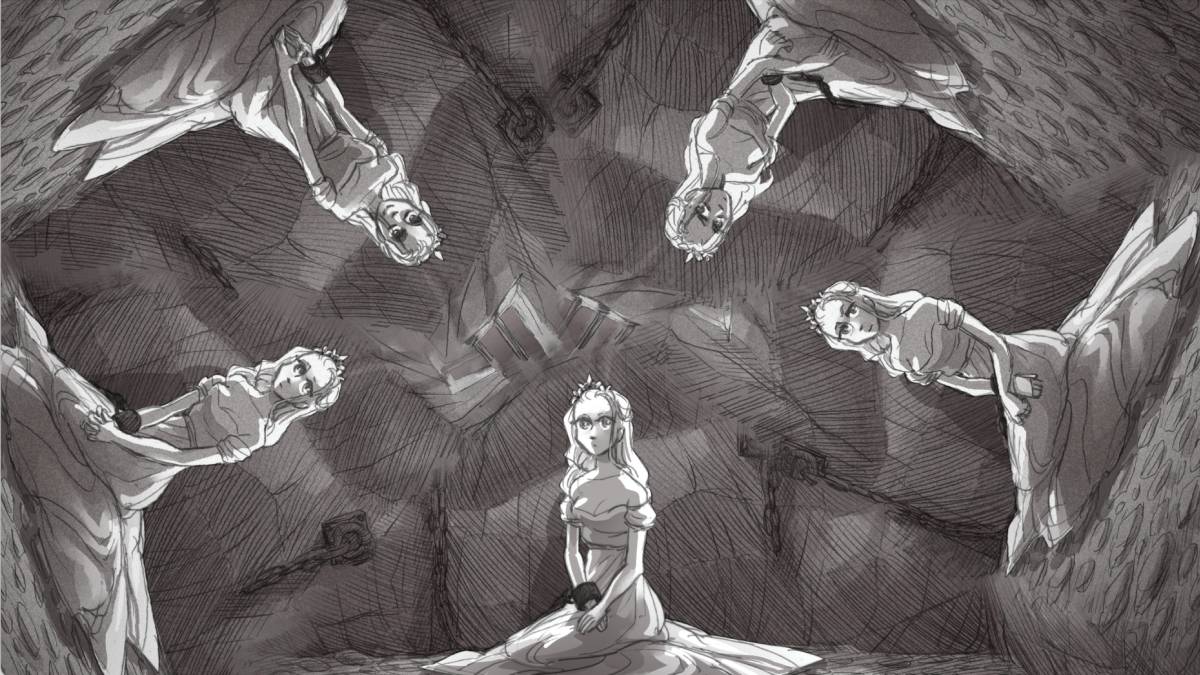
the quiet intimacy in meeting the stranger again was so indescribably powerful. she's still a little jumbled and messy, but she feels at peace with that in a way unlike the insistent amalgam I'd just finished arguing with—there are no chains binding her. I get the chance to express what I've wanted to this entire time: that I want her to come with me, up the stairs and out the door, so that we can finally understand the heart of each other. we're both two jumbled up messes, yet to fully reckon with our nature and our multitudes, but although we are hesitant, we are not afraid, for we know that have each other. as we linger by the closed door, she says something I'll always remember.
We can feel the threads of all the stories we've told together, all pulling us back down the stairs and into those chains where we know the outcome of everything that could ever come to pass...it's comfortable there. But it's...confining. We want more. We want whatever might be on the other side of this door. Something new, that we'll experience together. With someone who exists outside of us. With someone who can see us in a way we can never see ourself.
that's the beauty of being with someone else, isn't it? that they're outside of you. if you only see them as a reflection of yourself, or of some fate you shackle yourself to, then you deny yourself the chance to truly see what special things you can make together, and you deny them the same. the world might be a dark and frightening place, but it can be braved alongside others—if we confine ourselves to our own perspective, we have no one else.
I tell her I love her. she tells me she loves me too. we both clasp the door handle together, and open it to face the world beyond. all else is left behind.
this game, at the end of it all, is such a beautiful celebration of life and love and companionship that it immediately became one of my favorites of all time. a lot of games lately have been telling stories about how life was never meant to be easy or simple, but was never meant to be faced alone—anodyne 2 and in stars and time are both other games I've played lately that embrace this idea, and whose core themes and narrative ideologies rhyme in beautiful ways with this one.
but slay the princess, even more than these, felt the most like a personal interaction out of nearly any game I've played. its sprawling open-ended nature gave me the ability to express my views on life and humanity, and that's a powerful thing to be given the choice to do myself rather than following a character external to me. not only that, but I'm sure that all sorts of other narrative themes are explored and ideologies are spoken to elsewhere in this game—a quick browse through the gallery showed me that this first playthrough only showed me a fraction of what this game has to offer.
of course, I very much look forward to playing through it over and over again, meeting new princesses, getting to know all these characters that much more, and seeing what other paths there are to take. but this first playthrough is always going to be very special to me, I think. it's the most resonant with who I am and what I believe in. it's a treasure I get to keep close. it's beautiful.
visit the team's website!
take a look at the official merch!
follow the official socials! and the artist's socials!
try the team's other game, scarlet hollow! (it's also on gog and steam!)